Archive for March, 2007

Ophthalmology in Ayurveda

Friday, March 23rd, 2007

According to Vagbhata Samhita, there are 94 different diseases that attack eyes, Susrutha talks about 67 ophthalmologic diseases.

Nimi, the sage is considered to be the acharya of Netra Chikitsa (ophthalmologic treatment) and Sun the God of Eye. The different treatment options involved in Netra Chikitsa are Anjana (eye liner), Aschodana, Netra Tarpan, Pindi, Pudapakam, etc.

Keeping the lifestyle activities can help one keep his or her eyes healthy. The different reasons for most common diseases that affect the eyes are spending excess time in the sun, excess physical exertion, quickly moving to a cold place from a hot environment – like jumping into a swimming pool while sweating, stare an object for long, sleeping at daytime, sleeplessness at night, etc.

There are different kinds of Thimira (cataract), which has treatments other than surgery in its initial stages. However in advanced stages, surgery is the only option. Night blindness and infectious diseases also have different treatment options.

There are also six classes of optic diseases classified based on tridoshas -Vataja, Pittaja, Kaphaja, samsargaja, sannipathaja, and rakthaja. The treatment is suggested after considering the physical peculiarities of a person. Shirovasti and Nasya are also administered for treating diseases that affect the eyes.

Papaya -Ayurvedic Medicinal Plants

Friday, March 23rd, 2007

Papaya is a popular fruit found in all parts of India in almost all seasons. Papaya is consumed mostly in summer season. Papaya fruits have many properties – it helps in regularizing digestion and cleanses intestine. It also expels ringworms and hookworms.

The dried latex collected from unripe papaya fruits, papaine is used in the preparation of some Ayurvedic medicines used in the treatment of warts, moles, eczema, and skin allergies, etc. Medicines for arthritis is also find the use of papaine. Fresh cuts or wounds are also treated with applying the juice of a fresh fruit.

Apart from fruits, roots and leaves also have medicinal properties.

Papaya is a small tree, growing usually in the range of 2 to 10 metres.

Carica Papaya belongs to the family caricaceae and is popularly known as papaya, kaplanga, papanga (in Kerala), paw paw, Papaw, Kates, etc.

Nasya – Ayurvedic Treatments

Friday, March 23rd, 2007

Nasya or nasyam is an Ayurvedic treatment method, characterized by nasal administration of medicines. According to Ayurvedic concepts, nose is the opening of prana or life. Nasal administration of medicines easily takes the medicines to the brain and other vital parts. Nasal administration is mainly to remove excess dosha accumulated in the nose, throat and head area.

Prana is responsible for all mental activities including memory, thought process and concentration.

If there are difficulties to breath, Nasya is also a treatment method.

There are six types of nasya, they are:

1. Pradhamana nasya or virechan nasya uses powdered herbs, without any oils. The medicinal powder is blown into the nose with the help of a tube. Headaches, cold, etc are the main diseases treated this way.
2. Bruhana nasya uses animal or vegetable ghee, medicated milk, oil etc. It is also called nutrition nasya. Dry nose, difficulty in talking, heaviness of eyelids, loss of sensitivity to smell etc are the indications of bruhana nasya.
3. Shaman Nasya includes the application of medicinal decoctions or medicinal oils.
4. Navana Nasya uses both medicinal decoctions and oils together.
5. Marshya Nasya again is use of ghee or oil.
6. Prati Nasya is performed by the person himself on a daily basis, by dipping the small finger in ghee or oil (medicated or otherwise) and lubricating the nasal passage by inserting the wet finger as much as possible without causing pain or damaging the soft tissue.

Children below seven, people above 80 and pregnant women are not recommended for any kind of nasya therapies.

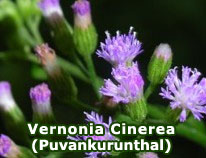
Poovam Kurunnu (Vernoia Cinerea) — Ayurvedic Medicinal Herbs

Friday, March 23rd, 2007

Poovamkurunnu (Vernoia cinerea) is an Ayurvedic herb that grows to the size of about ten to 35 inches. It is a branched herb and produces purple flowers, which are compound flowers (flowering heads) and produce many seeds, which are propagated by wind. It is found in wilderness and wastelands. It is wrongly considered a weed by farmers of different parts of India. The farmers in Kerala seem to know the medicinal value of this herb and donÂ’t use any harmful chemicals to eradicate this herb from the farmland.

Poovam kurunnu has different medicinal properties and used in different Ayurvedic medicines for skin conditions, leucorrhoea, intestinal worms, headaches, wounds and serious diseases like malaria. It has anthelmintic, antipyretic, properties.

The English names of this plant are iron weed and vernonia.

Vernoia cinerea belongs to the family Asteraceae.

Vashpa Swedan or Medicated Steam Bath

Friday, March 23rd, 2007

Though non-medicated steam bath is also recommended by different healthcare practitioners from across the world, steam from water medicated with Ayurvedic herbs has several specific benefits.

The major benefit of such a medicated steam bath is that it mobilizes accumulated ama (bodily wastes) that accumulates in different srota (body channels) and blocks the way of vital energy reaching different parts of the skin.

The steam is mainly aimed at swedan (sweating) to release the accumulated toxins. Steam bath is also supported by different steam bath boxes, in which the person can take a standing, sitting or lying down position. Fully medicated steam is passed to the chamber so that the person gets his body below neck completely bathe in medicated steam.

In addition to removing toxic wastes, Vashpaswedan also is beneficial in curing different skin problems like psoriasis.

Puli (Imli) or Tamarind, Tamarindus Indica -Ayurvedic Herbs

Friday, March 23rd, 2007

Puli (Tamarindus Indica) is used as a spice in different culinary preparations. Not only its dried ripe fruits, but also the leaves, flowers, and sprouts are taken in different situations. It is widely cultivated or grown naturally in abundance in almost all parts of India, especially towards the south. Puli is Malayalam word, imli or imali is Hindi and Tamarind is common English name for the plant.

The paste prepared by crushing the leaves is a quick remedy for boils and swellings. The leaves also have a cooling effect and hence used in the treatment of cold. It also relives liver congestion, chronic constipation etc. It is also an anti hemorrhoid.

Ayurveda and Marma Chikitsa

Friday, March 23rd, 2007

Marma chikitsa is a related more to kalarippayattu, the martial art form of Kerala. Marma, literally means a key point. According to Kalari payattu knowledge, there are 108 Marmas on human body. Twelve among them are extremely critical and are called Padumarma. Immediate death will be the result if any of these points are injured. There are 96 others marmas, collectively known as Thodu marmas, not as serious as padumarmas.

A shock to a marma (thattu in Malayalam) can be overcome by applying controlled negative shocks (maruthattu in Malayalam). In marma treatment, the injuries to marmas are treated. Ayurvedic medicines are used for massaging and treatments. Marma chikitsa also addresses dislocation of bones, out-of-shape bones, etc.

Marma massaging involves massaging the body while applying sufficient pressure over the marmas. Different medicinal oils are used in the massaging.

Though marma chikitsa is primarily associated with Kalari payattu, (martial art form of Kerala), Kathakali, the divine dance form of Kerala also benefits from marma chikitsa. It gives the body flexibility to perform different maneuvers.

Apart from giving flexibility to body muscles, the marma massage also enables the persons to attain a sharp mind, mental alertness, better composure, and natural resistance to almost all common diseases.

Marma massage is primarily called Thirummu chikitsa or Thirummal. Chavittithirumal is a special thirummal, in which the person is left bathed in medicated oil on floor. Then the masseur massages the body with his or her feet. A rope hanging from the roof keeps the masseur in balance.

Ayurvedic training in Kerala, especially in the salya tantra (surgery) division, marma tantra is an important item.

Marma Chikitsa is followed only in Kerala and in the southern parts of Tamil Nadu.

Puliyarila (Oxalis corniculata) — Indian Ayurvedic Herbs

Friday, March 23rd, 2007

Oxalis corniculata is an annual herb, used as a component for Ayurvedic medicine and has properties like diuretic and refrigerant. It is used treating disorders of liver and digestive problems. The herb has power to prevent certain cancerous growth. The leaf pulp is applied over insect bites and burns. Puliyarila also has antibacterial properties.

The plant is known as yellow sorrel.

Oxalis corniculata belongs to the family Oxalidaceae.

Friday, March 23rd, 2007

Ksheeradhooma is an Ayurvedic fomentation therapy with medicated milk of cow, generally given to face. It treats vata related disorders. Ksheeradhooma is not applied if kapha is also involved in the specific condition. Good for facial paralysis, certain nervous disorders, difficulty in voice and speech, head aches, etc. It is also given to other parts of the body. The medicated milk is boiled and the steam is passed through a tube to the affected area of the body.

Ksheera dhooma is a measure of swedan (fomentation). Safety measures need to observed for the safe administration of steam to the affected area. Medicated oil is applied to the area before steam is applied.

Ksheeradhooma is unique to Kerala method of Ayurveda.

Other possible spellings for ksheeradhooma can be ksheera dhooma, ksheeradooma, ksheera dooma, ksheeradhuma, ksheera dhuma, etc.

Punna (Calophyllum inophyllum) Ayurvedic Medicinal Plants

Friday, March 23rd, 2007

Punna (Calophyllum inophyllum) is an evergreen tree with smooth leaves and thick foliage. During flowering season, it produces small white flowers with few pink stripes. The flowers are fragrant. The fruits are spherical and sometimes a plaything for children, because of its resemblance to the shape and size of playing marbles. The fruit has a fleshy outer covering, inside which is a tough shell that protects the single large seed.

The tree can tolerate almost all kinds of weather conditions.

Oil extracted from the seeds has different medicinal uses. It is anti-inflammatory and has pain relieving properties. It is used in the treatment of rheumatism and arthritis. It also has use in treating different diseases affecting skin.

Carophyllum inophyllum belongs to the family Clusiaceae.

Friday, March 23rd, 2007

Ksharasutra is a special Ayurvedic treatment, which was developed recently. There is however very little thoughts on kshara sutra as medicated threads in Sushruta Samhita and Bhavprakasha. The specific treatment is used to cure anal fistula and piles. There are also researches going on to develop similar treatments for almost all kinds of skin diseases.

Kshar literally means ash. In kshara sutra, a thread is coated with Ayurvedic herbs 14 to 21 times. Kshar or kshara means a substance with alkaline (basic) properties. Each coating has different medicines and ash (kshar) of Ayurvedic herbs. The threads thus prepared are tied to the pile mass and kshar is applied to the affected area. There is complete medication for all the tissues of the area. When there are excess fibrous tissues, the cutting rate can slow down. In normal cases, it will cut through unwanted tissues at 1 cm (one cm) per week.

There are several advantages for ksharsutra over surgical procedures. The first among them is the little time required for hospitalization. There are no bleeding or painful dressings after the therapy. One can go back to his/her daily activities in as little as six hours after the process. However this is not a one-time process, but continues over a week, up to three. The length of the treatment depends on the extent of affected area. One can tell the number of sittings required after analyzing the state of the disease.

Another benefit is the very low recurring rate of 2%, which is minimal when compared to surgical procedure. The medicines coated in the thread heal the tissue completely. There will also be no big scars left after the procedure.