Archive for March, 2007

Friday, March 23rd, 2007

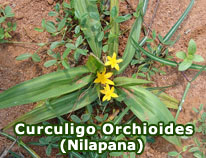
Nilappana (Curguliginis orchiodis rhizoma) is a very small herb, with the only showy parts being the long blade like leaves and tiny yellow flowers.

Nilappana in Malayalam literally means a ground palm. Nilam means ground or farmland and pana is a palm tree. One can see only the leaves radiating from a single point and three to eight yellow flowers the size of 6-8 mm.

Nilappana is used in both Ayurveda and Chinese system of medicines. The main usable part is the base of the plant, where one can hardly distinguish between the stem, ovary and fruits.

The roots have tonic effects and strengthen kidneys, muscles and bones. It is also used in the treatment of skin diseases, piles, asthma etc.

Curguliginis rhizoma belongs to the family amaryllidaceae.

Friday, March 23rd, 2007

Nirgundi (Vitex negundo) is an Ayurvedic herb. The leaves are made into a paste and applied over rheumatic swellings and over painful joints. The leaves are anti-bacterial, anti fungal, anti inflammatory and analgesic. It treats mild cuts and wounds. It is also an important cure for bruises and different kinds of skin infections.

Njaval (Syzygium cumini) — Ayurvedic Herbs

Friday, March 23rd, 2007

Syzygium cumini (myraceae family) is a plant that has made its presence on Asia, Europe, Africa, and North and South Americas. It is known by the names jamun, jambolan, njaval (njara – in Malayalam), Java Plum (in America), black plum, jaman, and many other names.

It is recognized as an Ayurvedic herb too. The leaves are antibacterial. The fruits of different variety are sour, sweet, astringent or acidic. The fruits are available only in specific seasons and are used for the treatment of diabetes, digestive and urinary problems, diarrhea, ringworms, etc. The bark and leaves are also used for various purposes.

Pacchoti (Symoplocos Laurina) Ayurvedic Herbs of India

Friday, March 23rd, 2007

Pacchoti (Symoplocos laurina) is a perennial herb, used in Ayurvedic medicines for diarrhea, biliousness, hemorrhages and certain diseases that affect eye.

Pachoti, pachotti, pacchotti, etc are spelling variations for this plant.

Symoplocos laurina belongs to the family symplocaceae.

Pashanbhedi (Bergenia Ligulata) Ayurvedic Herbs

Friday, March 23rd, 2007

Pashanbhedi (Bergenia ligulata) is an Ayurvedic herb, mainly used as a diuretic. The term pashan bhedi literally means something that breaks (bhed, bhedya) a stone (Pashana). It is reputed as an effective medicine to dissolve kidney stones.

The also forms part of treatments for fever, diarrhea, etc.

Pathimukham (Caesalpenia Sappan) — Ayurvedic Medicinal Herbs

Friday, March 23rd, 2007

Pathimukham (Caesalpenia sappan) is a perennial tree with pinnate compound leaves. Its pink-rose flowering also makes it an ornamental plant.

The flowers also form a base for Ayurvedic fairness creams. The heartwood produces a red color which is useful in coloring food and fabrics.

Pathimukham tree is cultivated for its medicinal value. Its bark, heartwood, flower and roots are all usable parts.

The water kept in the heartwood of pathimukam tree is rich in minerals and has diuretic, anti-oxidative, thirst quenching, anti-bacterial and tonic properties. It is also blood purifying and is a good drink for persons with diabetes. It cures jaundice, cough, respiratory problems, etc.

The other names are sappan wood and bukkum wood tree. It strives in different climatic conditions, except frost and drought.

Caesalpinia sappans belongs to the family Caesalpiniaceae.

Peruvalam (Clerodendron infortunatum) Ayurvedic Herbs of Kerala

Friday, March 23rd, 2007

Peruvalam (Clerodendron infortunatum) is a small herb with big leaves. It grows to a maximum height of 9”, with no branches and produce circular leaves with 6 inch diameter.

In Indian homeopathy, it is used as a remedy for diarrhea.

Peruvalam is used in post natal care.

It is also used to dress fresh wounds.

Clerodendron infortunatum belongs to the family Verbenaceae.

Friday, March 23rd, 2007

Pichu is associated with Ayurvedic oil massage therapy. It includes pressing parts body with cloth dipped in warm medicated oil. It is applied over areas that require treatments for different conditions.

Partial paralysis, rheumatism, and symptoms associated with nervous disorders are treated this way.
Siropichu
Siropichu means pichu given to siras or head. It is pichu therapy given to the head. It has different applications like cure to hair loss, increase eyesight, relieve stess, etc.

Friday, March 23rd, 2007

Podina is a perennial herb grown in high ranges and cold areas of India. It is also known by the names mint, pudina etc. It is used as a spice in some culinary preparations.

It has a soothing effect on respiration and is used in treating headache, cough, vomiting, sore throat, etc. Menthol and extraction from Podina is used in the preparation of certain pain balms and cold balms.

Mentha Arvensis comes in the plant family Lamiaceae.

Friday, March 23rd, 2007

Panikoorka (Pashanbheda – Coleus Aromaticus) is an Ayurvedic herb of Kerala, with various names – navara or navarayila, karpooravalli, omavalli, suganda, pashanbheda (pashanbhanda) etc. Its Latin name is also variable – Coleus aromaticus and Plectranthus amboinicus refer to the same plant.

The bluntly teethed leaves are fleshy with light green color. The stem is weak and spread on the ground. The stem and base will rot with water logging. Propagation is quite easy with stem cuttings.

Panikkoorka is used in the treatment of a variety of diseases affected by virus, bacteria and other microbes. Indigestion, diarrhea, rheumatism, whooping cough, bronchitis, tooth ache, etc are also treated with medicines prepared from the leaves of this plant. It is also an effective antidote for insect bites.

It is also used in the treatment of skin disorders, dandruff and different types of allergies.

Coleus aromaticus belongs to the family laminaceae.

Friday, March 23rd, 2007

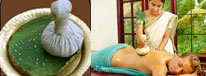
Patra panda sweda or patra panda swedan (elakizhi) is an Ayurvedic therapeutic measure to cure rheumatic complaints like joint pains and swellings. Herbal leaves are made into a panda (bolus) wrapped in a cloth, dipped in warm medicated oil and pressed against the body.

It is a tonic for both nervous and muscular systems. Chronic back pain, weakness of a limb, muscular cramps, stiffness, etc are cured with choice of herbal leaves. It also enhances blood circulation and promotes good metabolism.