Posts Tagged ‘Herbs Plants’

Ummam (Datura Stramonium) -Ayurveda Medicinal Plants

Friday, March 23rd, 2007

Ummam (Datura stramonium) is a quick growing wild perennial herb common in rural and semi forest areas of Kerala. The flowers look like creamy-white, long, large bells.

The fruits and roots of ummam are used in different Ayurveda medicines. The leaves are narcotic. They are used in the treatment of asthma.

Ummam is also the chief ingredient of Kanaka Asava, a preparatory Ayurvedic medicine.

Datura stramonium belongs to the family solanaceae.

Friday, March 23rd, 2007

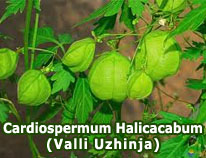
Uzhinja (Cardiospermum halicacabum), also known as balloon vine has different applications as an Ayurvedic herb. It is used to treat inflammations, itches, rashes, eczema, hives and allergic reactions. It is also used in the treatment of nasal sinuses. Ayurveda considers this herb as diuretic, emetic, laxative and refrigerant.

Vayambu (Acorus Calamus) — Ayurvedic Medicinal Herbs

Friday, March 23rd, 2007

Vayambu is given to small children and young students. It is believed to have a positive effect on mental development of the children.

The rhizome also has sedative properties and used in the treatment of epilepsy. It is also used in the treatment of dysentery, fever, kidney problems, rheumatism, certain skin problems, etc. Vayambu is a constituent of many traditional Ayurveda medicine preparations.

The English names of vayambu are sweet flag and calamus.

Acorus calamus is in the family Acoraceae.

Friday, March 23rd, 2007

Velipparuthi (Pergularia daemia) is a wild perennial climber with fleshy heart shaped leaves and bi-lobed fruits which bear several seeds, which are dispersed by wind with the help of silky fibers, which act as a parachute for the seed.

Velipparuthi literally means hedge-cotton. Velippadarthi is regional variation of the name of the plant.

The leaves have different medicinal properties. It is given to persons who have suffered from violent injury along with egg and preparatory medicines.

The plant is emetic and expectorant. A decoction prepared from the leaves in used in the treatment for asthma and diarrhea in children. The pulped leaves also are a component of medicinal paste to apply on rheumatic swellings.

Perularia daemia belongs to the family Asclepiadaceae.

Friday, March 23rd, 2007

Vidang (Embilia ribes) is used as a component for different Ayurveda medicines. It is soothing on nervous system and calms down mind and body. fruits, leaves and roots are all useful parts. It is used as a laxative. It is also used in the treatment of flatulence. It is anti-inflammatory and anti-carcinogenic. It is however, anti-fertile.

It comes in the plant family Myrcinaceae.

Vidhari Kand (Ipomoea Digitata) — Ayurvedic Herbs

Friday, March 23rd, 2007

Vidhari Kand (Ipomoea digitata) comes in the plant family of sweet potato. In Ayurveda it is used as a general tonic. It clears voice. It is used in the treatments of cough, liver disorders. It increases lactation.

It also is used in the treatment of several gastro-intestinal disorders, fungus attack, indigestion, hemorrhoids, respiratory problems, ulcers, obesity, and worms.

It is not good for sexual ability.

Embelia ribes comes in the plant family Myrsinaceae.

Friday, March 23rd, 2007

Vinca rosea is grown throughout India. It has certain properties to soothe the nervous system, and acts against restlessness. It also prevents the growth of cancerous cells. It is also an anti-depressant and relieves muscle pain. It has sedative and tranquilizing properties.

Though the white to light purple flowers are good to see, they smell very bad. In Malayalam, it is called savam nari poovu, which means it smells like a dead body.

Vinca Rosea is in the plant family apocynaceae.

Wheat Grass — Ayurvedic Herbs

Friday, March 23rd, 2007

Wheat grass (Triticum Aestivum) is a good source of nutrition like Vitamin A, C, E, iron, Calcium and flavonoids. Thus, wheat grass is more of a nutritional supplement than any medicine. However, recent researches have found that wheat grass has antibiotic, anti-inflammatory effects. Wheat grass is not generally viewed as a regular Ayurvedic medicinal herb.

Wheat grass can be administered for anemic persons as it has the capabilities to increase hemoglobin production. It also has purification properties, cleansing the blood and removal of wastes from the body.