Archive for March, 2007

Friday, March 23rd, 2007

Arali (Nerium indicum) is an ornamental plant known for its bright pink to red flowers. Though the flowers make great visual display, they are also highly poisonous.

The plants grow as big shrub, reaching a height of 3 m. The milky secretion from leaves and seeds has toxic effects. The plant is grown in almost all parts of Kerala India, except in frosty and desert conditions.

Propagation can be either through stem cuttings or seeds.

Arali, also common oleander or pink oleander has different medicinal properties too. It is used as a diuretic, expectorant and emetic.

Nerium indicum belongs to the family apocynaceae.

Arutha (Ruta Graveolens) -Flowers of Kerala

Friday, March 23rd, 2007

Arutha (Ruta Graveolens) is an perennial shrub that grows to a height of about 4-5Â’. The plant bears bunches of yellow flowers with about one cm diameter. The fruits bear many seeds.

Use of arutha as a vegetable or for culinary purpose is almost completely absent in India. It is reported that arutha had culinary importance in such cultures like Greek.

Arutha (English name is Rue) is used in homeopathic and Ayurvedic medicines. It is a wild variety found in forest or semi forest areas.

The oil extracted from arutha plant is anti-spasmodic and anthelmintic. It is used in the treatment of epilepsy (hysteria) and amenorrhoea.

Ruta graveolens belongs to the family Rutaceae.

Balipoovu (Aerva Lanata) Flowers of Kerala

Friday, March 23rd, 2007

Balipoovu (Aerva lanata) is a herbaceous plant that produces clusters of tiny white to pale red flowers.

The other names of balipoovu are cherula and cherpula. Balipoovu is also spelt balippoovu, balipoove, balippoove, bali poovu and other variations.

This herb is used in Ayurveda medicine. The main usable part is root.

The plant is often sites as the best cure for kidney stones.

There are different decoctions prepared from this plant, which are used in treating such serious diseases like gonorrhea, problems to kidney and bladder, diabetes, etc. Decoctions prepared from the root of this plant are also used in the treatment of different kinds of headaches.

Aerva lanata belongs to the family amaranthaceae.

Friday, March 23rd, 2007

Chempakam (Michelia champaca), also known as champac, is a flowering tree found in Kerala and almost all parts of India and South Asia.

Flowers of chempaka are used in the production of certain essential oils for aromatherapy.

This plant has different medicinal properties. They are stomachic, carminative, and are used in the treatment of nausea, fever, renal diseases, etc.

Mukkutti (Biophytum Sensitivum) -Flowers of Kerala

Friday, March 23rd, 2007

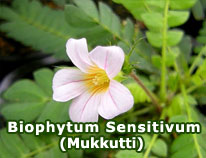
Mukkutti (Biophytum sensitivum) is a very small flowering plant, which has only a few pinnate leaves with 8-10 leaflets on either sides spreading out from a common base. Each leaflet measures 4-5 mm and the total length of the leaf is less than five cm. Each plant produces five to ten small flowers with yellow petals. Mukkutti is an important flower for the people of Kerala.

The flower is used in athapoo, special floral formation that adores courtyards and public places during Onam, the national festival of Kerala.

Ayurveda also see this little herb as a good medicine, used as a tonic, stimulant and in the treatment of stomachache, diabetes and asthma.

Biophytum sensitivum belongs to the family Oxalidaceae.

Friday, March 23rd, 2007

Mulla (Jasminum grandiflorum) is a world famous flower commonly found in home gardens of Kerala. Jasmine is the English name of Mulla and is known as the queen of flowers. The plant is known for the sweet fragrance of little milky-white flowers.

Jasmine is an ornamental flower. Women of almost all cultures in India wear a tiny garland of jasmine flowers in their hair. Hindu brides wear jasmine garlands in such a way to cover the long hair.

Ayurveda as well as other medical systems use jasmine (jati in Hindi) in treating excess stress and anxiety. It is also used in treating insect bites. It is also used in treating different types of headaches.

The essential oil is diuretic, astringent, anthelmintic, antidepressant, aphrodisiac and stimulant.

Aromatherapy essential oil from jasmine is extracted by distillation.

The essential oil obtained from the flowers is used in aromatherapy. The smell has powers to balance male and female hormone levels. It is also used to relieve nervous tension, depression, head aches, insomnia etc.

It is a good aphrodisiac too. The smell is sensual.

Jasminum grandiflorum belongs to the family Oleaceae.

Sankhupushpam (Clitoria ternatea) -Flowers of Kerala

Friday, March 23rd, 2007

Sankhupushpam (Clitoria ternatea) is a fast growing plant of pea family. The Malayalam word Sankhupushpam means a conch shaped flower. The plant grows very quickly and usually blooms in 6 to 10 weeks of sprouting as a seedling. The flower is blue-deep purple.

The Hindi word is Sankhapushpi and English words are blue pea and butterfly pea. This plant is found almost everywhere in the world and the place of origin is hard to trace.

The roots of this plant are used in Ayurveda medicines. The root extracts have demonstrated antidepressant properties.

Clitoria ternatea is in the plant family Fabaceae (or Leguminosae). Clitoria ternatea is also placed in papilionaceae.

Savam Nari (Catharanthus Roseus) Flowers of Kerala

Friday, March 23rd, 2007

Savam nari (Catharanthus roseus or Vinca rosea) is a wild herb that grows 8-10 inches and is used in Ayurveda medicines for its various medicinal properties.

Catharanthus roseus is the same plant known earlier as vinca rosea.

The Malayalam name of the plant, savam nari (literally means something that emits bad smell – nari as a corpse – savam) comes from the fact that the flowers smell like a corpse.

The flowers, like balsam are variously colored. They range from pure white to pink and a mixture of both.

The leaves, stem and flowers are toxic.

Ayurvedic medicines prepared from savam nari stem, leaves and roots are used to treat diabetes, hypertension, asthma, gastro-intestinal problems, and problems in female sexuality. Recent researches suggest its effectiveness in treating conditions like leukemia (blood cancer), skin cancer and breast cancer.

Catharanthus roseus belongs to the family Apocyanaceae.

Friday, March 23rd, 2007

Sooryakanthi (Helianthus Annuus), commonly known as sunflower got its name from two different facts that the flowers always face the sun and the shape of the flower resembles sun. Sooryan in Malayalam means sun and kanthi means beauty – suryakanthi is the beauty of sun.

Though it appears to be a single flower, sooryakanti is a head inflorescence with multiple flowers, each producing a seed. Sooryakanthi is an annual plant. In some cases, a plant produces only a single flower and then dies. In most cases it produces multiple flower heads.

The seeds of suryakanthi are diurectic and expectorant. The leaves of the plant is used in treating different skin diseases.

Helianthus annuus belongs to the family Asteraceae.

Friday, March 23rd, 2007

Japa pushpa or chemparathi (Hibiscus Rosa-sinensis) is a common ornamental flower found in all parts of India. The Latin name – Rosa Sinensis means rose of China. No one is sure if hibiscus originally comes from China or India. The flowering plant is found in all parts of India, except at frozen areas. The flowers can be of different colors and types. The medium sized blood-red colored is the most commonly found type. The petals are large. The number of petals can either be five or many in a compound flower as in a rose flower.

There are different plant breeding techniques that have produced more than 250 varieties of hibiscus plants, variously colored – white, yellow, pink, violet and red.

The flower has a prominent place in Ayurvedic beauty care or Ayurvedic hair care. The flowers and leaves are used in preparing natural hair shampoo that cleans the hair and fights dandruff, lice and premature greying.

Though hibiscus produces richly colored flowers it never produce fruits or seeds. Thus the only method of propagation is stem cuttings. A stem cutting of 9 to 15 inches is enough to produce a new plant in a new location.

Though there are accounts for African women using the flowers of hibiscus as ornaments, women in South Asia donÂ’t use it for ornamental purpose as there are several other flowers available.

Thazhuthama (Boerhavia Diffusa) -Flowers of Kerala

Friday, March 23rd, 2007

Thazhuthama (boerhavia diffusa), which is also known as punarnava (in Hindi, Sanskrit), is a small herb found in all parts of Kerala and India.

The herb reaches a maximum length of 10 inches and produces small purple flowers.

All parts of the plant are used in Ayurveda medicines. Thazhuthama roots are used in the treatment of asthma. It has diuretic and laxative properties too.

Boerrhavia diffusa belongs to the family Nyctaginaceae.