Archive for March, 2007

Jackfruit:

Friday, March 23rd, 2007

Jackfruit tree is found abundantly in almost all parts of Kerala. The fruit, seeds, leaves and roots have different medicinal properties. The stalk of leaves is used in the treatment of fever, boils and skin diseases. The young fruits are astringent. There are different variety of jackfruits, most of them are very sweet and have cooling properties. In the season, jackfruit, fully ripen and otherwise is the main diet for many families, especially of low-income brackets.

The seeds can create constipation, but is also believed to be an aphrodisiac.

Jatamamsi -Ayurvedic Herbs

Friday, March 23rd, 2007

Jatamamsi (Valeriana Wallichii) is a perennial herb found in most parts of India, Nepal and Bhutan. Jatamamsi rhizome or rhizome oil has soothing effect on nervous system and used in the treatment of insomnia, instability, epilepsy, hysteria, etc. It can also reduce restlessness and behavior problems in children.

Jatamamsi oil also promotes hair growth.

Valeriana Wallichii is in the plant family Valerianaceae.

Kadaladi (Achyranthes Aspera) — Ayurvedic Medicinal Herbs

Friday, March 23rd, 2007

Kadaladi (Achyranthes aspera), commonly known as prickly chaff flower is characterized by its prickly fruits, which hold on to cloths and skin with special hook-like structures. This probably is the sole method of propagation of seeds. The seeds are attached to the fur of animals, which are later dropped at another place, thereby facilitating propagation.

Kadaladi is an annual herb. Decoctions prepared by the whole plant have diuretic and astringent properties.

Achyranthes aspera belongs to the family Amaranthaceae.

Friday, March 23rd, 2007

Kalmegh (Andrographis Paniculata) is an Ayurvedic herb that has a wide range of applications to prevent and cure a variety of diseases and conditions. It is now widely used in America as a preventive measure and cure for common cold. For long, this herb has been used in India and other Asian countries to treat different kinds of infections, cold, fever, herpes, etc. This herb has potential to cure malaria, dysentery etc. There are also instances that Andrographis is used to cure snake bites. It also forms part of different Ayurveda medicines used to cure liver disorders, gall bladder functioning, digestion, etc.

The drug also keeps the heart healthy, avoid blood clotting within the blood vessels.

Friday, March 23rd, 2007

Kanjiram (Struchnos nuxvomica) is a large tree characterized for its bitter seeds and leaves. The tree easily reaches a height of above 35 m.

The bark, fruits and seeds are poisonous and possess medicinal properties at the same time. This tree is nature to Kerala coast and is found in the hotter areas of Kerala. The seeds and leaves are extremely bitter and hence the poison is of no great threat to health in ordinary conditions.

The bark, root, leaves and seeds are used in the preparation of different Ayurvedic medicines. The extracts have soothing effects on nervous system. It is used in the treatment of certain nervous disorders.

Strychnos nuxvomica belongs to the family loganiaceae.

Friday, March 23rd, 2007

Karpura (Cinnamomum Camphora) is an Ayurvedic herb used in the treatment of diarrhea, nervousness, muscular cramp, fever, etc.

Camphor has germ killer properties and it purifies atmosphere. It may be because of this property, almost all Hindu rituals end with offering of camphor fumes to the deity. It has strong aroma. Camphor is produced from Cinnamomum camphora trees that are older than 50 years. The whole tree or branches are cut, chipped and boiled in water. Camphor floats in the water, which is cooled and solidified for use and storage.

It is useful in the treatment of measles, whooping cough, typhoid, rheumatism, toothache, and various problems to digestive system. Only a very small dose is required.

Cinnamomum camphora is in the plant family lauraceae.

Kayyonni -Ayurvedic Medicinal Herbs of India

Friday, March 23rd, 2007

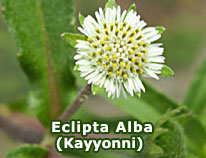
Kayyoni (Eclipta alba/eclipta prostrata) is a small herb, traditionally used in Kerala as an important ingredient for coconut hair oil prepared at home. The herb has protective features against dandruff and pre-mature hair graying.

Application of coconut oil boiled with kayyonni on head is also beneficial for coolness of head and eye-sight. It is also taken internally as an astringent, purgative, emetic, and tonic. It is used in the treatment of liver diseases, anemia, diphtheria, etc.

The plant grows in swampy places. It is also found in dry areas where there is extended presence of water at least in the rainy season.

The plant is dried for storage. Propagation is through seeds, which scatters in air.

Eclipla prostrate belongs to the family Asteraceae.

Khadira (Acacia catechu) -Ayurvedic Herbs

Friday, March 23rd, 2007

Khadira (Acacia catechu) is used in Ayurveda to treat cough, sore throat etc. The wood extracts contain elements that have antibacterial, anti-fungal and anti-inflammatory properties.

It is a perennial tree.

In Malayalam it is known as Karingali. Drinking water is boiled with dried karingali powder. It acts as an appetizer too.

Acacia catechu belongs to plant family mimosaceae.

Friday, March 23rd, 2007

Keezharnelli (Phylantus fratemus) is a common medicinal herb found throughout Kerala in farm lands and wastelands. Keezharnelli is a very small herb reaching 15 to 40 cm height and 1-3 mm thickness. The leaves bear fruits on the bottom side (hence the name keezharnelli), which gives the feel of miniature version of nellikkai (amalaki).

Ashtavaidyas of Kerala used this herb to treat jaundice. It is an effective protective measure for liver.

Kodangal (Centella Asiatica) Ayurvedic Medicinal Herbs

Friday, March 23rd, 2007

Kodangal (Centella asiatica) is a highly esteemed herb in Ayurveda. The plant spreads on the ground and new plants develop at nodes, where the plant produces roots and new branches. The leaves are rounded with 1-1.5 inch diameter.

The other names for kodangal are gotu kola, Indian pennywort etc.

Different clinical trials have repeatedly proved the different medicinal effects of Centella asiatica in treating patients with such conditions like diabetes, venous hypertension, edema, pregnancy-stretch marks etc. Careful administration of Centella asiatica is also beneficial in treating rheumatism, arthritis, skin diseases, circulatory problems, senility and varicose veins. Centella asiatica also has positive influence on better brain functioning and concentration, extra vitality and in lowering blood sugar levels.

Centella asiatica belongs to the family Apiaceae.

Kolinchi — Ayurvedic Medicinal Herbs

Friday, March 23rd, 2007

Kolinchi (Zingiber zerumbet), also known as wild ginger is a wild variety of plant in ginger family that grows to a height of 7 ft or more. The underground stem holds the leaves and a peculiar conical inflorescence, which holds distant resemblance with pine cones. The leaves appear to be arising from a stem. The inflorescence too appear on a pseudo-stem.

Kolinchi is the Malayalam word. The other names for this plant are shampoo ginger and pinecone.

The plant grows quickly. Propagation is through rhizomes. A single piece of rhizome is enough to turn an entire area covered with the plants in two to three years.

The shampoo of the plant is produced at the bracts after the flowers are shed. This liquid is base for different herbal shampoo products.

Kolinchi or shampoo ginger has different medicinal properties too. It is used in Ayurveda medicines in the treatment of muscle cramps, indigestion, asthma, skin diseases, cough etc. It is also used as a vermicide.