Posts Tagged ‘Herbs Plants’

Friday, March 23rd, 2007

Mulberry is cultivated mainly for its leaves, which is the food for silkworm caterpillars. Mulberry fruits are compound fruits with size 2-3 cm. Its color turn dark purple when ripe and is very sweet, but sour when not fully ripe.

Mulberry fruits is used in the treatment of general weakness, fatigue, anemia, dizziness, etc. it can also improve digestion by promoting gastric juice production and eliminating constipation. Mulberry leaves can promote sweating. The bark has blood pressure lowering properties.

Mulberry is known throughout India in the same name.

Morus Alba (mulberry) is in the plant family Moraceae.

Murikoodi (Hemigraphis colorata) Ayurvedic Medicinal Herbs

Friday, March 23rd, 2007

Murikoodi (Hemigraphis colorata) got its name from the fact that it is a quick healer of fresh cuts and wounds. Muri or murivu in Malayalam means a cut or wound and kooduka means to gather and here it refers to wound healing. Thus murikoodi can be translated into a wound-healer.

Different experiments have proved the effectiveness of this herb with red-purple stem and leaves in curing wounds and its antiseptic properties.

Due to its special color, it is used as an ornamental plant and aquarium plants. However, it is hard for the plant to survive underwater for longer periods of more than a few months.

Hemigraphis colorata belongs to the family acanthaceae.

Muthanga (Cyperus rotundus) -Ayurvedic Herbs

Friday, March 23rd, 2007

Muthanga (Cyperus rotundus) — Ayurvedic Herbs Cyperus rotundus (family cyperaceae), also known as nut grass is an Ayurvedic herb. It finds its application in a variety of medicinal compositions. It is found almost throughout the world, but is widely regarded as a weed because of the quick propagation.

In Ayurveda, muthanga (also called Musta, motha, mutha, korai, granti, mustako, nut grass, coco grass, etc) is used in treating blood diseases, skin inflammations etc. It is also used in the treatment of leprosy. Root is the usable part. It has cooling effect on body.

Friday, March 23rd, 2007

Naikkurana parippu, has a special position in Ayurvedic medicines. It is the best known male sex enhancer. It gives fullness to both internal and external sexual organs, gives vitality and passion. Its use is safe for women too. Increased volume of ejaculate, agility, quick erection, lubrication, stamina, increased libido and sexual thought, stiff erection, etc are also the results of the use of naikkurana. (Other spellings are naykkurana, nayikkurana, nayi kurana, nay kurana, nai kurana, etc).

Its ability to fight ParkinsonÂ’s disease is also found in different researches. Mucuna pruriens (scientific name) is also known to facilitate the production of growth hormones, which in turn will give a revitalizing effect on nervous tissues. It has positive effects on memory, clarity of thought, concentration, and mental alertness.

The herb is also known by the terms horny goat weed, kiwanch (Sanskrit), cowhage (in western languages), etc. Naikkurana is Malayalam word. It is also called velvet bean. The herb comes in the bean family and there are no side effects associated with its use.

Researches have found that the use of Mucuna pruriens for 20 days increased sperm count by 16% and increased the action of spermatozoids. It also stimulates the action of pituitary gland, and increased the amount of male sex hormones in the blood.

This herb can very well be named herbal Viagra because of the increased libido a person experiences with the use of the herb.

Mucuna pruriens comes in the plant family Fabaceae (Leguminose).

Friday, March 23rd, 2007

Naruneendi (Hemidesmus indicus) is a small semi erect climbing shrub used as an Ayurvedic herb. The root of this herb is used as a tonic, blood purifier, and diuretic. It is also used in the treatment of rheumatism, skin infections and diseases to urinary tract.

It is a tonic and strengthens bodily and mental functioning. It can function like alterative, demulcent, diaphoretic. It can also act as a blood purifier and balance different nutritional imbalances. It is used in the treatment of rheumatism and arthritis. Certain skin diseases and urinary problems too are treated with decoctions prepared from naruneendi root.

The root of this plant also has medicinal properties to treat insect bites. It is also used in the treatment of such serious diseases like gonorrhea, leucoderma, jaundice, dysentery, etc. Naruneendi (or narunindi) root is also used in the treatment of piles with painful bleeding.

Naruneendi is also known by the names Indian sarasaparilla anantamul, ananthamoola, sariva, etc.

Hemidesmus indicus belongs to the family Asclepiadaceae.

Neela Amari (Indigo ferra Tinctora) -Ayurvedic Medicinal Herbs

Friday, March 23rd, 2007

Neela amari (Indigofera tinctora) or neelamari is a perennial woody shrub that reaches the height of up 35 inches.

It is used in the cure for nervous disorders, epilepsy, and used as an ointment for piles. Decoctions prepared from the root of the plant are used for urinary problems.

Indigofera tinctora belongs to the family Fabaceae (Leguminosae).

Neem -Ayurvedic Medicinal Herbs

Friday, March 23rd, 2007

Neem (common name Arya Vep, (Azadirachta Indica) finds a variety of uses in Ayurvedic medicines. The medicinal quality of Neem or vep is described in the Vedas written some 3000 to 5000 years ago. Ancient people of India, in fact used to call a neem tree as a “village pharmacy”.

Ayurvedic medicines aimed at blood purification uses neem as a prime component. They are also used in the treatment of diabetes. The leaves, bark, and fruit have bitter taste, even smelling can be tough. It is the best option to remove internal and external parasites like bacteria, fungus, amoeba etc.

Freshly broken soft twig has traditionally been the natural toothbrush of people. It protected their teeth and gums from infections of all kinds. The tradition of using neem twigs for brushing is almost extinct now.

They are also used to treat a variety of skin conditions like psoriasis, eczema, acne, dandruff, warts, etc.

Neem is also used to treat heart diseases, hypertension, blood clots, excess cholesterol, kidney problems, digestive and nervous disorders, STD, etc. However, preparing medicines for such disorders is highly technical task.

The leaves, oil, seed, and bark has insect repellant properties. Neem oil, which has both medicinal and insect repellant properties is extracted from its seeds. Neem seed cake is a good manure. All parts of neem are used in one way or other.


Friday, March 23rd, 2007

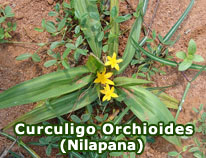
Nilappana (Curguliginis orchiodis rhizoma) is a very small herb, with the only showy parts being the long blade like leaves and tiny yellow flowers.

Nilappana in Malayalam literally means a ground palm. Nilam means ground or farmland and pana is a palm tree. One can see only the leaves radiating from a single point and three to eight yellow flowers the size of 6-8 mm.

Nilappana is used in both Ayurveda and Chinese system of medicines. The main usable part is the base of the plant, where one can hardly distinguish between the stem, ovary and fruits.

The roots have tonic effects and strengthen kidneys, muscles and bones. It is also used in the treatment of skin diseases, piles, asthma etc.

Curguliginis rhizoma belongs to the family amaryllidaceae.

Friday, March 23rd, 2007

Nirgundi (Vitex negundo) is an Ayurvedic herb. The leaves are made into a paste and applied over rheumatic swellings and over painful joints. The leaves are anti-bacterial, anti fungal, anti inflammatory and analgesic. It treats mild cuts and wounds. It is also an important cure for bruises and different kinds of skin infections.

Njaval (Syzygium cumini) — Ayurvedic Herbs

Friday, March 23rd, 2007

Syzygium cumini (myraceae family) is a plant that has made its presence on Asia, Europe, Africa, and North and South Americas. It is known by the names jamun, jambolan, njaval (njara – in Malayalam), Java Plum (in America), black plum, jaman, and many other names.

It is recognized as an Ayurvedic herb too. The leaves are antibacterial. The fruits of different variety are sour, sweet, astringent or acidic. The fruits are available only in specific seasons and are used for the treatment of diabetes, digestive and urinary problems, diarrhea, ringworms, etc. The bark and leaves are also used for various purposes.

Pacchoti (Symoplocos Laurina) Ayurvedic Herbs of India

Friday, March 23rd, 2007

Pacchoti (Symoplocos laurina) is a perennial herb, used in Ayurvedic medicines for diarrhea, biliousness, hemorrhages and certain diseases that affect eye.

Pachoti, pachotti, pacchotti, etc are spelling variations for this plant.

Symoplocos laurina belongs to the family symplocaceae.