Posts Tagged ‘Herbs Plants’

Friday, March 23rd, 2007

Karpura (Cinnamomum Camphora) is an Ayurvedic herb used in the treatment of diarrhea, nervousness, muscular cramp, fever, etc.

Camphor has germ killer properties and it purifies atmosphere. It may be because of this property, almost all Hindu rituals end with offering of camphor fumes to the deity. It has strong aroma. Camphor is produced from Cinnamomum camphora trees that are older than 50 years. The whole tree or branches are cut, chipped and boiled in water. Camphor floats in the water, which is cooled and solidified for use and storage.

It is useful in the treatment of measles, whooping cough, typhoid, rheumatism, toothache, and various problems to digestive system. Only a very small dose is required.

Cinnamomum camphora is in the plant family lauraceae.

Kayyonni -Ayurvedic Medicinal Herbs of India

Friday, March 23rd, 2007

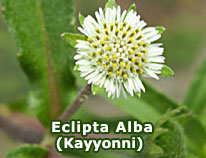
Kayyoni (Eclipta alba/eclipta prostrata) is a small herb, traditionally used in Kerala as an important ingredient for coconut hair oil prepared at home. The herb has protective features against dandruff and pre-mature hair graying.

Application of coconut oil boiled with kayyonni on head is also beneficial for coolness of head and eye-sight. It is also taken internally as an astringent, purgative, emetic, and tonic. It is used in the treatment of liver diseases, anemia, diphtheria, etc.

The plant grows in swampy places. It is also found in dry areas where there is extended presence of water at least in the rainy season.

The plant is dried for storage. Propagation is through seeds, which scatters in air.

Eclipla prostrate belongs to the family Asteraceae.

Khadira (Acacia catechu) -Ayurvedic Herbs

Friday, March 23rd, 2007

Khadira (Acacia catechu) is used in Ayurveda to treat cough, sore throat etc. The wood extracts contain elements that have antibacterial, anti-fungal and anti-inflammatory properties.

It is a perennial tree.

In Malayalam it is known as Karingali. Drinking water is boiled with dried karingali powder. It acts as an appetizer too.

Acacia catechu belongs to plant family mimosaceae.

Friday, March 23rd, 2007

Keezharnelli (Phylantus fratemus) is a common medicinal herb found throughout Kerala in farm lands and wastelands. Keezharnelli is a very small herb reaching 15 to 40 cm height and 1-3 mm thickness. The leaves bear fruits on the bottom side (hence the name keezharnelli), which gives the feel of miniature version of nellikkai (amalaki).

Ashtavaidyas of Kerala used this herb to treat jaundice. It is an effective protective measure for liver.

Kodangal (Centella Asiatica) Ayurvedic Medicinal Herbs

Friday, March 23rd, 2007

Kodangal (Centella asiatica) is a highly esteemed herb in Ayurveda. The plant spreads on the ground and new plants develop at nodes, where the plant produces roots and new branches. The leaves are rounded with 1-1.5 inch diameter.

The other names for kodangal are gotu kola, Indian pennywort etc.

Different clinical trials have repeatedly proved the different medicinal effects of Centella asiatica in treating patients with such conditions like diabetes, venous hypertension, edema, pregnancy-stretch marks etc. Careful administration of Centella asiatica is also beneficial in treating rheumatism, arthritis, skin diseases, circulatory problems, senility and varicose veins. Centella asiatica also has positive influence on better brain functioning and concentration, extra vitality and in lowering blood sugar levels.

Centella asiatica belongs to the family Apiaceae.

Kolinchi — Ayurvedic Medicinal Herbs

Friday, March 23rd, 2007

Kolinchi (Zingiber zerumbet), also known as wild ginger is a wild variety of plant in ginger family that grows to a height of 7 ft or more. The underground stem holds the leaves and a peculiar conical inflorescence, which holds distant resemblance with pine cones. The leaves appear to be arising from a stem. The inflorescence too appear on a pseudo-stem.

Kolinchi is the Malayalam word. The other names for this plant are shampoo ginger and pinecone.

The plant grows quickly. Propagation is through rhizomes. A single piece of rhizome is enough to turn an entire area covered with the plants in two to three years.

The shampoo of the plant is produced at the bracts after the flowers are shed. This liquid is base for different herbal shampoo products.

Kolinchi or shampoo ginger has different medicinal properties too. It is used in Ayurveda medicines in the treatment of muscle cramps, indigestion, asthma, skin diseases, cough etc. It is also used as a vermicide.

Koovalam (Aegle Mermelos) Ayurvedic Medicinal Herbs of India

Friday, March 23rd, 2007

Koovalam (Aegle mermelos) is a sacred tree to Indian Hindus. It is related to citrus and has many names in India. Koovalam (kuvalam) or vilmam are Malayalam names, while Bel or bael in Hindi, Kuvalum in Tamil, and Kumbala in Kannada. They are also known as golden apple, stone apple and such names in English.

It is used while offering prayers to Lord Shiva. It is also planted in the premises of temples.

It grows in almost all climatic conditions in wilderness. The tree is slow growing and reaches a maximum height of 8-9 meters. The pale green leaves are aromatic. The fruits can be oval or spherical and has the size of a large orange. Koovalam fruits are edible. People eat it either raw or make a good jam.

The bark of the tree is toxic. It can kill freshwater fish.

Koovalam fruit has astringent properties and regulate digestive functioning. It is also used in curing diarrhea and dysentery.

Koovalam is also known as Kovalam, Bael Fruit Tree, Bilva, Vilva, Siriphal, Baed and Bel.

Aegle marmelos belongs to the family rutaceae.

Krishna Tulsi and Ayurveda

Friday, March 23rd, 2007

Probably a Krishna Tulsi (also Krishna tulasi, Krishna Thulasi) is the most revered and adored plant in Hinduism. Every Hindu family has at least a tulsi plant in their courtyard, usually in a raised platform just before the entrance to the house. It is the favorite plant of Lord Vishnu and is associated with Lord Krishna.

There is a variety of tulsi plants, but only Krishna tulsi (ocimum sanctum) gets a special reverence by Hindu families of India. The same species, Ocimum Sanctum, has two varieties – one with green leaves – Rama Tulsi and one with deep purple leaves – Krishna Tulsi. Though only Krishna Tulsi is held with reverence, both have the same medicinal properties.

Apart from the religious auspiciousness, Krishna Tulsi is connected to Ayurveda because of the different medicinal properties of this herb. It is because of the medicinal benefits that you can find at least a tulsi plant in any courtyard in Kerala.

It is a first aid like tonic for common diseases like coughing. Almost all of Ayurvedic medicines for cough –syrups or capsules – have tulsi as a major component. Freshly plucked leaves are also a medicine for fever, common cold, etc. One can just chew the leaves. It is also the major ingredient of special medicinal coffee (it has no real coffee content). Water boiled with tulsi leaves and cooled is effective to bring down fever of children.

Tulsi is also used in treating respiratory disorders like bronchitis, asthma, influenza, etc. It contains other medicinal herbs and spices like cloves or pepper. Tulsi leaves, when taken with honey can expel kidney stones. It requires a balanced diet also, with a lot of green vegetables for complete effectiveness of the treatment.

A healthy person can chew four to six tulsi leaves a day. It brings several benefits like normal blood sugar levels, healthy heart, prevention of ulcers, higher levels of physical endurance, lowered blood cholesterol level and can even act as a stress buster. Recent scientific studies have brought to light the powers of Tulsi to act as an adaptogen. It lowers instances of production of adrenal hormones commonly associated with stress.

Tulsi leaves have mosquito and head lice repellent properties. They are also used in treatment for insect bites.

Do you still wonder why this biannual herb got so much of a place of reverence from people of India?


Kuppacheera (Amaranthus Viridis) — Herbs of Kerala

Friday, March 23rd, 2007

Kuppacheera (Amaranthus viridis) was used as a vegetable similar to spinach in different parts of Kerala, but the use of this plant as a vegetable is largely diminishing. The leaves are the edible parts. Kuppacheera literally means spinach from rubbish.

Kuppacheera is an annual plant that reaches the height of 10-14 inches. Its flowers are similar to that of spinach. It grows in wastelands and almost all types of reasonably drained soil.

In Ayurveda medicine, decoctions prepared from kuppacheera are used in the treatment of diabetes. Different medicine systems also suggest the use of this plant as an astringent and vermifuge. It is also used in treating dysentery and inflammation.

Propagation is through seeds, which have less than one mm diameter.

Amaranthus viridis belongs to the family Amaranthaceae.


Kurunthotti (Sida Rhombifolia) -Ayurvedic Herbs

Friday, March 23rd, 2007

Sida rhombifolia is an Ayurvedic herb, used in the treatment of a variety of conditions including female infertility. Maha bala or mahabala is the Hindi-Sanskrit name of Kurunthotti (or kurumthotti – Malayalam word for sida). It is a very small perennial plant. Leaves, stem, bark and roots are usable parts.

Kutaj (Holarrhena Antidysenterica) -Ayurvedic herbs

Friday, March 23rd, 2007

Kutaj is an Ayurvedic herb used mainly to cure amoebic dysentery. Its Latin name, ‘antidysenterica’ suggests its prime use as a cure to dysenetery. The herb is also beneficial in treating other gastric disorders. The bark is the main usable part in treating dysentery.

Its flowers and seeds too have medicinal properties. While the flowers give appetite, the seeds are astringent, cooling and appetizing.