Posts Tagged ‘Flowers’

Friday, March 23rd, 2007

Japa pushpa or chemparathi (Hibiscus Rosa-sinensis) is a common ornamental flower found in all parts of India. The Latin name – Rosa Sinensis means rose of China. No one is sure if hibiscus originally comes from China or India. The flowering plant is found in all parts of India, except at frozen areas. The flowers can be of different colors and types. The medium sized blood-red colored is the most commonly found type. The petals are large. The number of petals can either be five or many in a compound flower as in a rose flower.

There are different plant breeding techniques that have produced more than 250 varieties of hibiscus plants, variously colored – white, yellow, pink, violet and red.

The flower has a prominent place in Ayurvedic beauty care or Ayurvedic hair care. The flowers and leaves are used in preparing natural hair shampoo that cleans the hair and fights dandruff, lice and premature greying.

Though hibiscus produces richly colored flowers it never produce fruits or seeds. Thus the only method of propagation is stem cuttings. A stem cutting of 9 to 15 inches is enough to produce a new plant in a new location.

Though there are accounts for African women using the flowers of hibiscus as ornaments, women in South Asia donÂ’t use it for ornamental purpose as there are several other flowers available.

Thazhuthama (Boerhavia Diffusa) -Flowers of Kerala

Friday, March 23rd, 2007

Thazhuthama (boerhavia diffusa), which is also known as punarnava (in Hindi, Sanskrit), is a small herb found in all parts of Kerala and India.

The herb reaches a maximum length of 10 inches and produces small purple flowers.

All parts of the plant are used in Ayurveda medicines. Thazhuthama roots are used in the treatment of asthma. It has diuretic and laxative properties too.

Boerrhavia diffusa belongs to the family Nyctaginaceae.

Thechi (Ixora Coccinea) -Flowers of Kerala

Friday, March 23rd, 2007

Thechi (Thetti – Ixora coccinea) is a wild variety of shrub that produces colorful flowers. The flowers appear in bunches and with four petals. Color is usually red, but there are also varieties of yellow, purple and exotic combinations of colors.

The flower is called flame of the woods in English and Meetha phool (means sweet flower) in Hindi.

Asoka tree (Saraca Indica) grows as a tree of more than 15” height also produces similar looking flowers. The tree is called Asoka tetti in Malayalam.

The dwarf plant doesnÂ’t grow beyond 12-14 inches and appears as a small insignificant herb. But such dwarf variety produces a berry like fruit, which is edible. The fruits have two to three small seeds. The taste is mild sweet to tasteless.

Ixora coccinea belongs to the family rubiaceae.
 

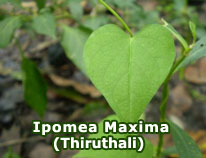
Thiruthali (Ipomea Maxima) -Flowers of Kerala

Friday, March 23rd, 2007

Thiruthali (Ipomea maxima) is a small climbing herb found in forests and areas of water proximity. The plant produces a bell-flower of 2” diameter.

The juice of the plant has diuretic properties. Thiruthali stem and root are also useful in treating arsenic poisoning.

Ipomea maxima belongs to the family Convolvulaceae.

Thumba (Leuca Indica) -Flowers of Kerala

Friday, March 23rd, 2007

Thumba (Leuca indica) is a very small herb that grows as four or five branches of five to eight inches right from the base. The very small flowers, to the tune of 6 to 8 mm are milky white in color. Someone in the past has found out a similarity in the shape of the bottom of foot of a new-born baby and the flower. You can see thumba flower that resembles a baby foot if you look at it with a baby in mind.

The flower is native to Kerala and rarely found outside Kerala. Ayurvedic medicines use the whole plant for different medicines. The flower has religious importance too. It is believed that Lord Krishna especially loved this flower.

It also forms part of offering to dead people during a special rite called vavu bali or karkidaka vavu bali, on the new moon day of Malayalam month Karkkidakam. The flowers are also used in posthumous Hindu rituals.

During onam, the national festival of Kerala, this flower is used in the special floral formation called athapoo.

Thumba flower signifies purity and simplicity.

Vella Koduveli (Plumbago Zeylancia) Flowers of Kerala

Friday, March 23rd, 2007

Vella koduveli is a wild perennial herb, found all over Kerala. The small herbaceous plant produces bunches of jasmine-like flowers. The plant got the name from the color of the flower (vella means white and koduveli is the name of the plant lÂ’s in vella is pronounced like l in ‘callÂ’ and the ‘l’ in koduveli is pronounced like the ‘l’ in ‘loveÂ’).

The plant is used in Ayurvedic medicine. The roots have diuretic properties. Vellakkoduveli is used in the treatment of diarrhea, piles, fever and certain skin diseases.

Plumbago zeylancia belongs to the family Plumbaginaceae.

Friday, March 23rd, 2007

Marigold is a common beautiful garden plant in India. Marigold is an annual plant that grows two to four feet high and produce beautiful golden flowers. Varieties of plants produce flowers of other colors like deep saffron too.

The flowers have antiseptic and healing properties, hence used in healing fresh wounds and cuts. It is also used to treat skin inflammations, eczema etc. The flowers, leaves, and roots are preserved by drying.

In Kerala marigold is known by the name jamanti.

Calendula Officinalis is in the plant family Asterceae.

Rose -Flowers of Kerala

Friday, March 23rd, 2007

Perhaps no one in this world would fail to identify a rose. It would be curious to know that rose petals are used in Ayurveda to treat a variety of diseases and conditions like hypertension, asthma, bronchitis, circulatory problems, diarrhea, common cold, fever, insomnia, palpitation, infections in urinary tract, stress, and restlessness etc.

The use of rose extracts in aroma therapy is well known. The smell has a soothing effect on nervous system.

Rosa centrifolia is in the plant family rosaceae.

Ummam (Datura Stramonium) -Ayurveda Medicinal Plants

Friday, March 23rd, 2007

Ummam (Datura stramonium) is a quick growing wild perennial herb common in rural and semi forest areas of Kerala. The flowers look like creamy-white, long, large bells.

The fruits and roots of ummam are used in different Ayurveda medicines. The leaves are narcotic. They are used in the treatment of asthma.

Ummam is also the chief ingredient of Kanaka Asava, a preparatory Ayurvedic medicine.

Datura stramonium belongs to the family solanaceae.